
☼ BaruaBd ☼
  • Home
  • Gallery
  • Tipitaka Bangla
  • Video
  • Mp3
  • BD Buddhism
  • Seevali Thero
  • Dhammapada
  • Sutta Pitak
  • Majjhima_Nikay
  • Mulpariyayabagga 1
  • Mulpariyayabagga 2
  • Sihonadobaggo
  • Opommobagga
  • Mhayamakabagga
  • Cullayamakabagga
  • Blog
  • Pajjimapannasapali
  • Dhammapada Bangla Post
  • Buddhist Song 1

  Tipitak Bangla

Picture
Picture
Picture
Picture

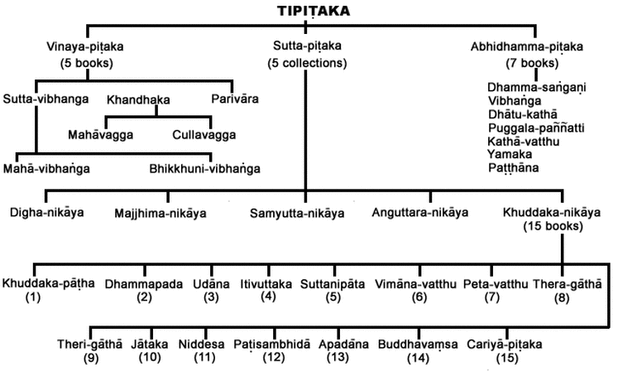
                     Structured Tree Flow of 

Picture

            Sutta Pitak

Picture

        Vinay Pitak

Picture

Abhidhamma Pitak

Picture

The ultimate objective in Buddhism is attained by purifying and improving mind. However, understanding what “mind” is a quite complicated act for any person. This is a barrier for someone who is interested in learning Buddhism in-depth. One of the teachings in Buddhism which provides a comprehensive analysis on mind is “Abhidhamma”.
The Buddhist doctrine is categorized into three, which is known to anyone, as “Thripitaka” namely Suthra Pitaka, Vinya Pitaka and Abhidhamma Pitaka. Vinaya Pitaka consists rules of conduct for Sangha and Suthra Pitaka consists of Suttas containing the central teachings of Buddhism. Suthra Pitaka is mostly on “Conventional Teachings” (Sammuthi Dheshana) of Buddhism. Abhidhamma Pitaka provides a theoretical framework for the doctrine principles in Suthra Pitaka which could be used to describe “Mind and Matter”. Hence, Abhidhamma embraces the “Ultimate Teachings” (Paramaththa Dheshana) in Buddhism.
Abhidhamma Pitaka consists of seven treatises; 
1. Dhammasangani
2. Vibhanga
3. Dhatukatha
4. Puggalapannatti
5. Kathavatthu
6. Yamaka
7. Pattthana
The term “Abhidhamma” simply means “Higher Doctrine”. It is an in-depth investigation to mind and matter. It answers many intricate points of Dhamma. It analyses complex machinery of human, world, mind, thoughts, thought-process, mental formations and etc. Therefore it is indeed a complex doctrine to understand. However, there are many who are interested in learning this beautiful branch of doctrine. Amongst them there are plenty of non-Buddhists as well. This effort is to present this doctrine in an “Easy to Understand” manner. 


Powered by Create your own unique website with customizable templates.